
Case Study: Achieving Water Clarity in a Florida Residential Community
An up-and-coming residential community partnered with Pure Polymer Solutions to improve water clarity across five ponds near new construction. The goal was to maintain clear, visually appealing water in high-traffic areas while protecting environmental health. Although most ponds already met regulatory standards, the project required treatment that achieved superior clarity without increasing chemical load or ecological risk.
Pond A
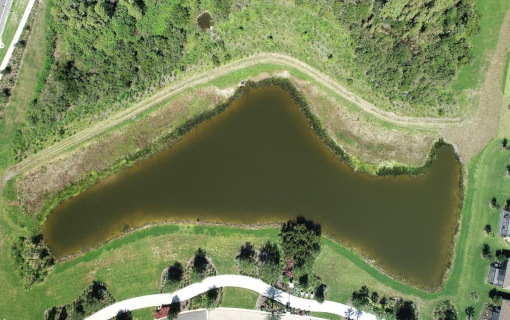
Analytic results showed: 8.47 pH, 6.02 NTU, 155 PCU, 0.243 Phosphorus. The water appeared clear with some vegetation. Turbidity and color were low, though phosphorus levels suggested a eutrophic state vulnerable to algal blooms.
Before
After

Lab Testing
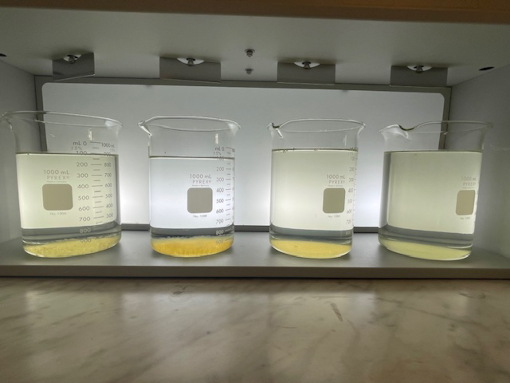
A range of coagulants and flocculants was tested. The most effective solution was a spray-applied metal-based coagulant followed by a liquid flocculant polymer. This combination lowered turbidity to 0.394 NTU and phosphorus to 0.057 mg/L while maintaining a near-neutral pH of 8.20.
Field Results
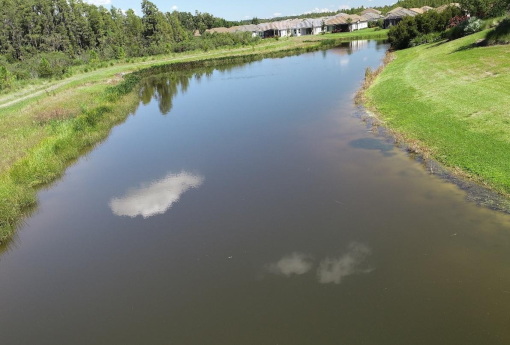
Pre-treatment turbidity measured 7.26 NTU. Post-treatment results dropped to 0.314 NTU, achieving a 96% reduction.
Before
After

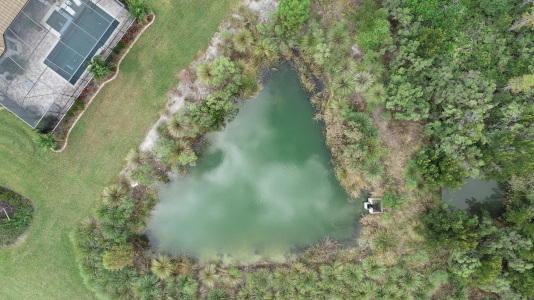
Pond B
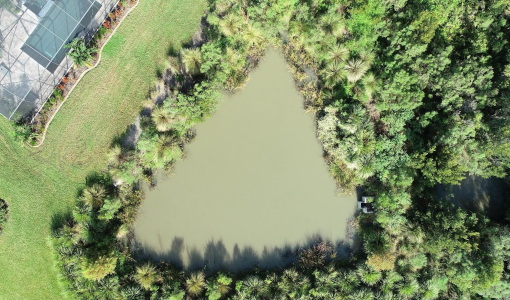
Baseline data recorded: 7.23 pH, 56.8 NTU, 582 PCU, 42 mg/L total alkalinity, and 2.24 mg/L phosphorus. The water was cloudy and light brown, likely due to construction runoff.
Baseline data recorded: 7.23 pH, 56.8 NTU, 582 PCU, 42 mg/L total alkalinity, and 2.24 mg/L phosphorus. The water was cloudy and light brown, likely due to construction runoff.
Before
After
Lab Testing
After multiple trials, the same metal-based coagulant and liquid polymer sequence was recommended. Results showed improved clarity (5.64 NTU), reduced phosphorus (0.366 mg/L), and a balanced pH of 7.50.

Field Results
Field readings showed turbidity decreased from 58.4 NTU to 2.43 NTU, a 96% reduction.
Before

After

Pond C
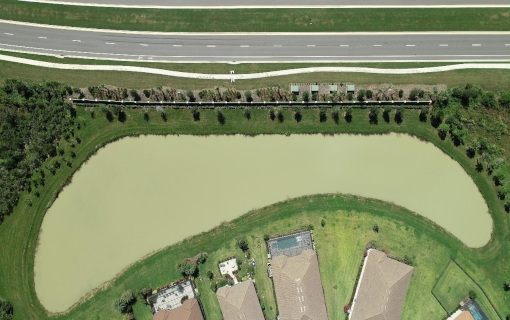
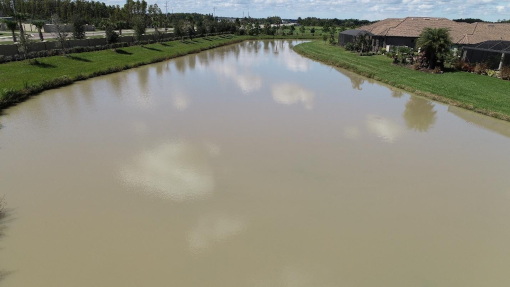
Measurements: 6.64 pH, 119 NTU, 1010 PCU, and 1.64 mg/L phosphorus. Water appeared cloudy and tan, likely affected by construction runoff.
Before
After

Lab Testing
Initial treatment mirrored prior tests but required adjustments. After retesting, a lower dose of the same chemistry proved most effective, lowering turbidity to 0.961 NTU and phosphorus to 0 mg/L, while maintaining safe zeta potential levels (-22.5 mV).

Field Results
Before treatment: 121 NTU. After treatment: 1.87 NTU, resulting in a 98% reduction.
Before
After
Pond D
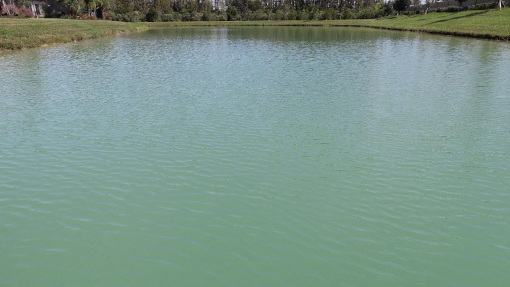
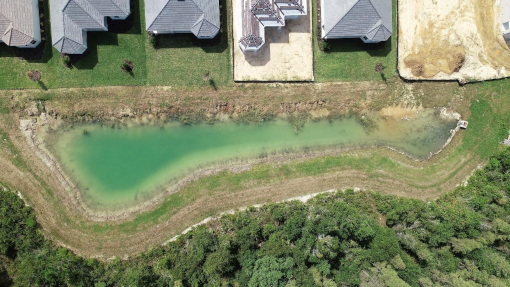
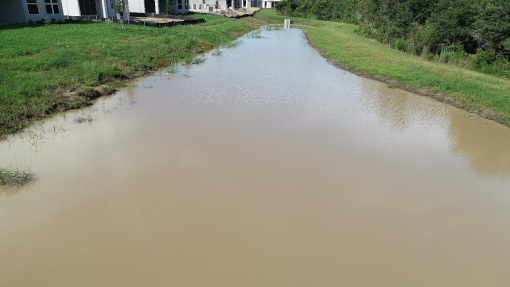
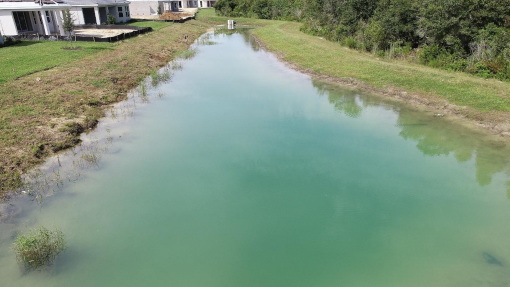
Data collected: 8.13 pH, 83.7 NTU, 758 PCU, 1.23 mg/L phosphorus. The water was light brown, most likely due to sediment runoff.
Before
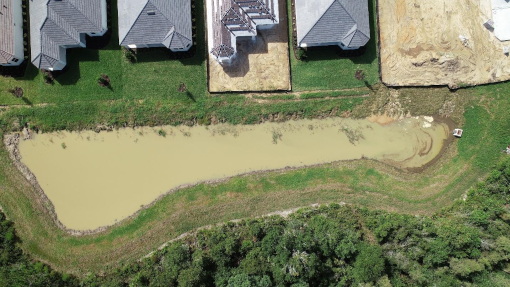
After
Lab Testing
Two effective treatments were identified: a metal-based coagulant and a plant-derived starch mixture, both followed by a liquid flocculant polymer. Each achieved significant turbidity and phosphorus reduction while maintaining safe pH levels (7.88–7.91). The starch-based chemistry provided slightly better clarity with minimal environmental impact.
Field Results
Turbidity decreased from 86.7 NTU to 5.34 NTU, achieving a 94% reduction.
Before
After
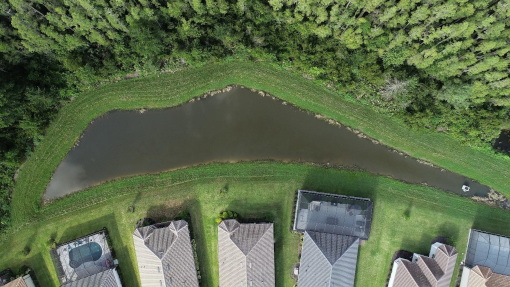
Pond E
Results showed: 7.43 pH, 15.7 NTU, 242 PCU, 2.18 mg/L phosphorus. Water appeared clear, and treatment objectives centered on visual enhancement without disturbing the ecosystem.
erable to algal blooms.
Before
After

Lab Testing
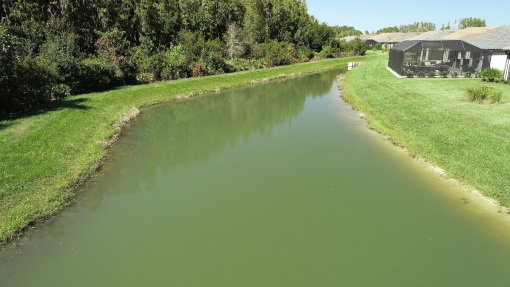
The most successful method involved a metal-based coagulant followed by a liquid flocculant polymer. It reduced turbidity to 2.62 NTU and phosphorus to 0.369 mg/L, keeping pH neutral (7.39).

Field Results
Turbidity was reduced from 18.5 NTU to 3.68 NTU, marking an 80% reduction.
Conclusion
Across five ponds, Pure Polymer Solutions achieved turbidity reductions ranging from 80% to 98%, improving clarity and color while protecting aquatic health. It’s always a greater challenge to reduce turbidity when turbidity is quite low to begin with. This project highlights the importance of a science-based, customized approach to water clarification. Instead of forcing a single product to work, Pure Polymer Solutions leveraged its expertise to design a targeted solution that respected the delicate chemistry of each water body.
By investing in a thorough diagnostic phase, the client gained more than just clarity; they gained efficiency. Establishing baseline values for each pond meant treatments could be tailored precisely, using only the chemistry required. This avoided overdosing, reduced overall chemical use, and delivered cost savings alongside reliable compliance.
Partner with Pure Polymer Solutions for Your Water Challenges
Whether you’re managing a residential community, a municipal reservoir, or an industrial process, effective coagulation is key to achieving water quality goals. Our team of experts specializes in developing customized flocculant and coagulant solutions that are both effective and efficient.
Ready to achieve crystal-clear results? Contact Pure Polymer Solutions today for a consultation and let us analyze your water challenges.